


Sierra Nevada Adventures Multi Day Rides
49er Adventure Ride
 Easy
Easy
 Mild
Mild
 Moderate
 Moderately Challenging
 Challenging
 Difficult
 National Park
 Highway
 Scenic
 Curvy
Curvy
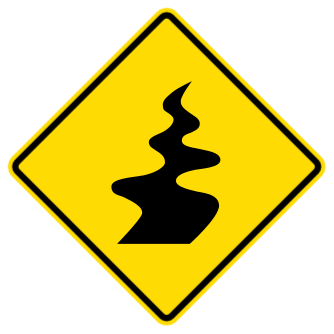 Twisty
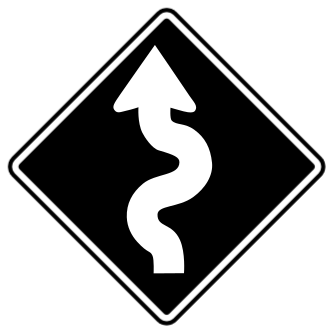 Goat Road
Next Ride: April 11th - 12th 2026
Remaining Spots: 15
Cost: $320.00 |
Member Cost: $295.00
.jpg) 49ER ADVENTURE RIDE
49ER ADVENTURE RIDE
The 49er ADVENTURE ride EXPLORES an amazing OFF-ROAD journey through the heart of the Mother Lode region. This route travers scenic dirt roads that wind through rolling foothills and storied Gold Rush towns, immersing riders in both remote terrain and rich history.
The 49er Adventure Ride offers an unforgettable journey to visit a historical area that was once the stomping grounds of the notorious Mexican bandit Joaquín Murrieta, adding a layer of legend to the ride. Along the way, participants will also pass a historic bull-and-bear fight site dating back to the California Gold Rush—an unusual and fascinating glimpse into the era’s past.
Your unforgettable journey also includes a visit, the Knights Ferry Covered Bridge is the longest covered bridge west of the Mississippi River. This historic bridge was constructed in 1863 to replace an earlier bridge destroyed by the catastrophic Great Flood of 1862. Engineered using the Howe truss design, the bridge remains a notable example of mid-19th-century craftsmanship and innovation. During the California Gold Rush, the bridge operated as a toll crossing and served as a critical link for commerce and travel across .jpg) the Stanislaus River. Its presence helped establish Knights Ferry as an important transportation and supply point in the region. Although closed to vehicular traffic in the 1980s, the bridge has been carefully preserved and remains open to pedestrians. Today, it stands as a significant historical landmark, connecting the historic town of Knights Ferry with nearby natural recreation areas and preserving a tangible link to California’s Gold Rush era.
the Stanislaus River. Its presence helped establish Knights Ferry as an important transportation and supply point in the region. Although closed to vehicular traffic in the 1980s, the bridge has been carefully preserved and remains open to pedestrians. Today, it stands as a significant historical landmark, connecting the historic town of Knights Ferry with nearby natural recreation areas and preserving a tangible link to California’s Gold Rush era.
Mother Lode History: The Mother Lode is central to the story of California’s 1849 Gold Rush, which drew thousands of prospectors—known as the 49ers—to the Sierra Nevada foothills in search of fortune. Early miners focused on placer gold found in streams and riverbeds. As surface deposits diminished, attention turned to hard rock mining, following gold-bearing quartz veins deep underground. The name Mother Lode refers to these rich quartz veins and is believed to derive from the Spanish term veta madre, meaning “mother vein,” or the source from which all gold originates. Although highly productive, these veins were not continuous, requiring extensive exploration across the region. The discovery of gold rapidly transformed California, fueling explosive population .jpg) growth, economic development, and paving the way for statehood in 1850. Today, the legacy of this era endures in the historic mining towns, landmarks, and preserved routes that line Highway 49, offering a lasting connection to California’s Gold Rush heritage.
growth, economic development, and paving the way for statehood in 1850. Today, the legacy of this era endures in the historic mining towns, landmarks, and preserved routes that line Highway 49, offering a lasting connection to California’s Gold Rush heritage.
The California Gold Rush (1848–1855): The California Gold Rush was the most significant and productive gold rush in American history, reshaping California’s population, economy, and landscape. From 1848 to 1855, miners extracted an estimated 750,000 pounds (approximately 750 tons) of gold, valued at hundreds of millions of dollars at the time and tens of billions of dollars today. Gold production reached its peak in 1852, when roughly $90 million worth of gold was recovered in a single year. Early prospectors relied on simple techniques such as panning and sluicing in streams and riverbeds. Over time, mining operations became increasingly sophisticated and capital-intensive, leading to the rise of large mining companies and diminishing opportunities for individual miners. While these methods increased yields, they also caused widespread environmental damage and influenced mining practices worldwide.
.jpg) Migration and the “Forty-Niners”: The discovery of gold sparked one of the largest migrations in U.S. history. Approximately 300,000 people traveled to California during the Gold Rush. About half arrived by sea, while the rest endured dangerous overland journeys along the California Trail and California Road. The majority of newcomers were Americans, but thousands also came from Latin America, Europe, Australia, and China. These gold seekers became known as the “Forty-Niners,” a name derived from the peak immigration year of 1849. The rapid influx of settlers had devastating effects on Indigenous peoples. Native communities were displaced, attacked, and driven from their lands as miners flooded the goldfields. While a small number of individuals amassed great fortunes, most prospectors found little success and earned no more than they had before arriving. To support the booming population, agriculture and ranching expanded across California. Towns and cities grew rapidly, most notably San Francisco, which expanded from a small settlement of roughly 200 residents in 1846 to a bustling city of about 36,000 by 1852. Roads, schools, churches, and new communities spread throughout the state. Transportation improved with the arrival of regular steamship service, and in 1869, railroads linked California to the eastern United
Migration and the “Forty-Niners”: The discovery of gold sparked one of the largest migrations in U.S. history. Approximately 300,000 people traveled to California during the Gold Rush. About half arrived by sea, while the rest endured dangerous overland journeys along the California Trail and California Road. The majority of newcomers were Americans, but thousands also came from Latin America, Europe, Australia, and China. These gold seekers became known as the “Forty-Niners,” a name derived from the peak immigration year of 1849. The rapid influx of settlers had devastating effects on Indigenous peoples. Native communities were displaced, attacked, and driven from their lands as miners flooded the goldfields. While a small number of individuals amassed great fortunes, most prospectors found little success and earned no more than they had before arriving. To support the booming population, agriculture and ranching expanded across California. Towns and cities grew rapidly, most notably San Francisco, which expanded from a small settlement of roughly 200 residents in 1846 to a bustling city of about 36,000 by 1852. Roads, schools, churches, and new communities spread throughout the state. Transportation improved with the arrival of regular steamship service, and in 1869, railroads linked California to the eastern United .jpg) States. The population surge accelerated California’s path to statehood. In 1849, residents drafted and approved a state constitution and elected an interim governor and legislature. Just one year later, in September 1850, California was admitted to the Union. The Gold Rush left a legacy of rapid development, technological innovation, cultural transformation, and profound social consequences that continue to shape the state today.
States. The population surge accelerated California’s path to statehood. In 1849, residents drafted and approved a state constitution and elected an interim governor and legislature. Just one year later, in September 1850, California was admitted to the Union. The Gold Rush left a legacy of rapid development, technological innovation, cultural transformation, and profound social consequences that continue to shape the state today.
Joaquín Murrieta History: Joaquín Murrieta is one of the most legendary and controversial figures of the California Gold Rush. Often described as the “Mexican Robin Hood,” he emerged during a time of intense racial violence and discrimination against Mexican miners in the Sierra Nevada foothills. According to popular accounts, Murrieta began as a prospector but was driven to outlaw life after experiencing brutal prejudice, including the lynching of his brother and the assault of his wife. These events are believed to have fueled his transformation into a vengeful bandit seeking retribution against Anglo-American miners. Murrieta led a feared outlaw gang through the Mother Lode region, robbing and killing miners and stealing horses throughout the foothills. While regarded as a criminal by authorities, he became a folk hero to others, symbolizing 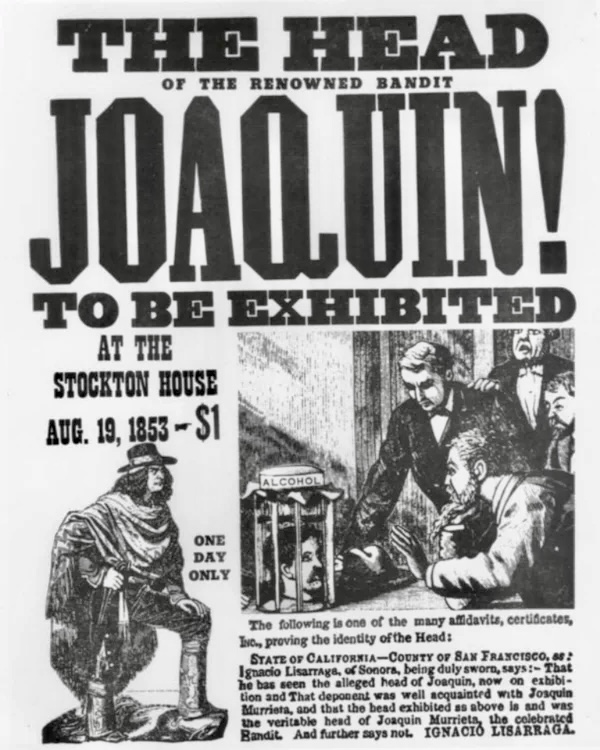 resistance against oppression during the Gold Rush era. In 1853, Murrieta was reportedly tracked down by California Rangers led by Captain Harry Love. His death was sensationalized when his severed head was displayed as proof of the bounty placed upon him. Once a hopeful prospector, Murrieta’s violent life and mysterious end became immortalized in American folklore, securing his legacy as the quintessential “Mexican Robin Hood.”
The death of Joaquin Murrieta: By 1853, the California state legislature listed Murrieta as one of the so-called “Five Joaquins”, suspected criminals, in a bill passed in May 1853. The legislature authorized hiring for three months a company of 20 California Rangers, veterans of the Mexican War, to hunt down "the five Joaquins, whose names are Joaquin Muriati, Joaquin Ocomorenia, Joaquin Velenzuela, Joaquin Botellier, and Joaquin Carillo, and their banded associates." On May 11, 1853, the governor, John Bigler, signed an act to create the "California State Rangers," to be led by Captain Harry Love (a former Texas Ranger and Mexican War veteran).
 The state paid the California Rangers $150 a month and promised them a $1,000 governor's reward if they captured the wanted men. On July 25, 1853, a group of rangers encountered a band of armed Mexican men near Arroyo de Cantua on the edge of the Diablo Range near Coalinga. In the confrontation, three of the Mexicans were killed. The rangers claimed one of the dead was Murrieta, and another, Manuel Garcia, also known as Three-Fingered Jack, one of his most notorious associates. Two others were captured. As proof of the outlaws' deaths, the Rangers cut off the hand of Three-Fingered Jack, and the alleged head of Murrieta. They preserved these in a jar of alcohol to bring to the authorities to claim their reward. Officials displayed the jar of remains in Mariposa County, Stockton, and San Francisco. The rangers took the display throughout the gold country, charging spectators $1 to see the severed head of Joaquin Murrreta and the hand of Three-Fingered Jack.
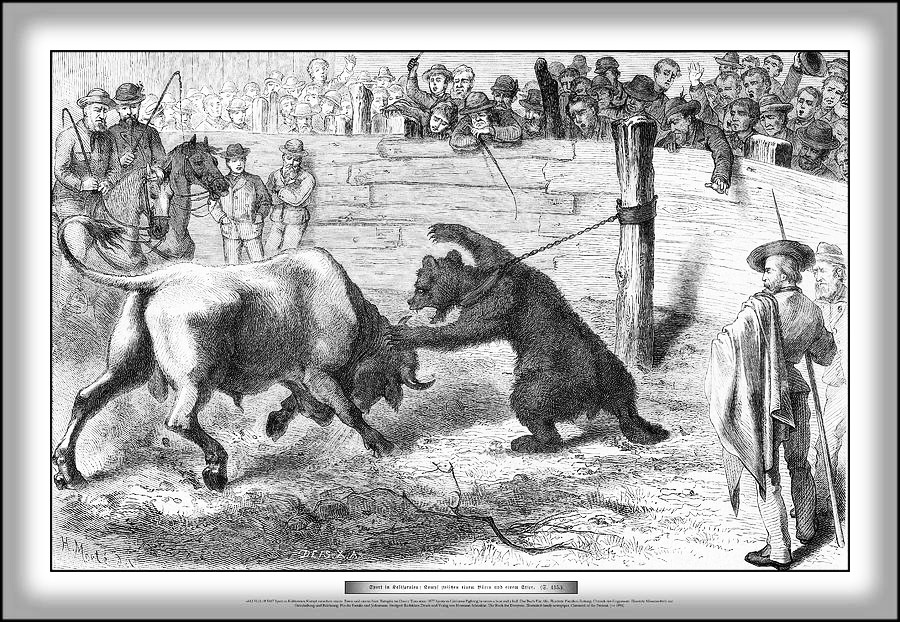
.jpg) Bear and Bull Fights in Early California: Before Spanish contact in the 16th century, California was home to an estimated 10,000 grizzly bears. By the 19th century, these animals became central to a violent and widely attended form of entertainment: bear-and-bull fighting, a bloodsport that took hold in California’s valleys, coastal regions, and emerging Gold Rush towns. Bear-baiting was introduced to California by Spanish conquistadors, though the practice itself dated back to ancient Rome and medieval Europe. In Middle Ages London, permanent amphitheaters known as bear-gardens were built for such events. In California, however, the venues were far more crude and temporary. Known as bull and bear “pits,” they were constructed from split-board fencing reinforced with heavy logs and adobe.
Bear and Bull Fights in Early California: Before Spanish contact in the 16th century, California was home to an estimated 10,000 grizzly bears. By the 19th century, these animals became central to a violent and widely attended form of entertainment: bear-and-bull fighting, a bloodsport that took hold in California’s valleys, coastal regions, and emerging Gold Rush towns. Bear-baiting was introduced to California by Spanish conquistadors, though the practice itself dated back to ancient Rome and medieval Europe. In Middle Ages London, permanent amphitheaters known as bear-gardens were built for such events. In California, however, the venues were far more crude and temporary. Known as bull and bear “pits,” they were constructed from split-board fencing reinforced with heavy logs and adobe.
These barbaric events typically took place on Sunday afternoons after church, becoming a curious blend of religious observance and violent spectacle. Townspeople gathered as families: women and children watched from raised viewing platforms, while men remained on horseback outside the barricades, armed with raetas (braided oxhide lassos), rifles, and revolvers in case a bear escaped.
.jpg) Historian Hubert Howe Bancroft, writing in California Pastoral, described these gatherings as festive community occasions, noting the eagerness with which crowds assembled following Sabbath services. Before the main event, vaqueros restrained the grizzly and often provoked it into aggression. The bear-and-bull fight served as the centerpiece of a larger program that included cockfighting, dogfighting, horse racing, and displays of horsemanship, sharpshooting, and lasso skills—public demonstrations of courage and skill meant to impress the crowd. When the fight began, well-dressed caballeros—men of social standing—led the shackled bear and bull into the pit. The animals were tied together with a rope long enough to allow movement but short enough to force confrontation. An official fired a pistol to signal the start as the crowd pressed forward in anticipation. Typically, the bull attacked first, charging with head down and horns forward. The bear often rose onto its hind legs, defending itself before striking with powerful swipes or crushing bites. Eyewitness accounts frequently claimed the bear held the advantage, with some bears fighting—and killing—multiple bulls in succession. Vaqueros occasionally intervened to save a bull and prolong the spectacle. Fighting Styles and Outcomes, observers noted the contrast between the two animals: the bull relied on speed and forward momentum, while the bear fought defensively, using strength, claws, and teeth. Outcomes varied depending on the age and condition of the animals, with victories alternating between bull and bear.
Historian Hubert Howe Bancroft, writing in California Pastoral, described these gatherings as festive community occasions, noting the eagerness with which crowds assembled following Sabbath services. Before the main event, vaqueros restrained the grizzly and often provoked it into aggression. The bear-and-bull fight served as the centerpiece of a larger program that included cockfighting, dogfighting, horse racing, and displays of horsemanship, sharpshooting, and lasso skills—public demonstrations of courage and skill meant to impress the crowd. When the fight began, well-dressed caballeros—men of social standing—led the shackled bear and bull into the pit. The animals were tied together with a rope long enough to allow movement but short enough to force confrontation. An official fired a pistol to signal the start as the crowd pressed forward in anticipation. Typically, the bull attacked first, charging with head down and horns forward. The bear often rose onto its hind legs, defending itself before striking with powerful swipes or crushing bites. Eyewitness accounts frequently claimed the bear held the advantage, with some bears fighting—and killing—multiple bulls in succession. Vaqueros occasionally intervened to save a bull and prolong the spectacle. Fighting Styles and Outcomes, observers noted the contrast between the two animals: the bull relied on speed and forward momentum, while the bear fought defensively, using strength, claws, and teeth. Outcomes varied depending on the age and condition of the animals, with victories alternating between bull and bear.
Lasting Influence: Though brutal, bear-and-bull fights left a lasting cultural legacy. The opposing fighting styles—aggressive bulls and defensive bears—inspired the modern financial terms “bull market” and “bear market.” What began as frontier entertainment ultimately shaped language still used today, linking California’s early gold rush history to the vocabulary of global finance.
Event Details:
Multi-Day Tour: (15 to 20 riders with a max of 20 riders)
This ride is DESIGNED for lightweight, middleweight to heavyweight ADVENTURE motorcycles.
OFF-ROAD terrain is rated easy, mild, moderate, and plenty of adventure.
Ride distance approx. 400 miles round trip (125 miles dirt roads)
Gas stops (135-mile range required)
MEETING TIME: 8:30 a.m. (ride starts at 9:00 a.m.)
MEETING LOCATION: Mel & Faye’s Dinner, Jackson, CA.
Mel's Diner 31-CA88 Jackson, CA 95642.
Please arrive in the morning with a full tank of gas.
MEALS: (Meals not included)
Breakfast and dinner at restaurants.
Bring water, snacks, and lunch.
HOTEL RECOMMENDATIONS: (Hotel not included)
Riders are responsible for booking their hotel reservations.
SATURDAY NIGHT: Oakhurst, CA.
Fairfield Inn & Suites By Marriott 40780 CA-41 Oakhurst, CA.
Note: Additional hotels available in Oakhurst, CA.
OPTIONAL HOTEL Before Event: (Hotel not included)
SNA members receive a DISCOUNT on hotels. You MUST CALL to receive your discount.
Best Western Amador Inn, 200 South Highway 49, Jackson, CA. 95642 (209) 223-0211.
Note: Additional hotels available in Jackson, CA.
Truck/trailer your bike? Please book accommodation at your hotel.
Note: The ride returns to Jackson, CA. on the last day, approx. 4:30 p.m.)
Questions email: mark@SierraNevadaAdventures.com
.jpg)
.jpg)

.jpg)
.jpg)
.jpg)
.jpg)
.jpg)

.jpg)
.jpg)
.jpg)
.jpg)
.jpg)
.jpg)
.jpg)
.jpg)
.jpg)
.jpg)
.jpg)
.jpg)
.jpg)
.jpg)
.jpg)
.jpg)
.jpg)
.jpg)
.jpg)
.jpg)
.jpg)
.jpg)
.jpg)
.jpg)
.jpg)
.jpg)
.jpg)
.jpg)
.jpg)
.jpg)
Still Have Questions?