


Sierra Nevada Adventures Multi Day Rides
CABDR High Sierra Ride
 Easy
Easy
 Mild
Mild
 Moderate
 Moderately Challenging
 Challenging
 Difficult
 National Park
 Highway
 Scenic
 Curvy
Curvy
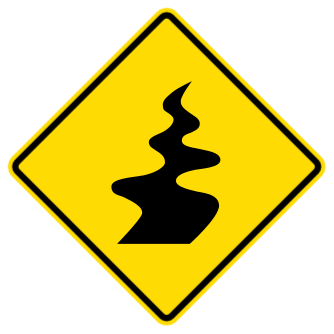 Twisty
 Goat Road
Next Ride: June 26th - 28th 2026
Remaining Spots: 17
Cost: $520.00 |
Member Cost: $495.00
.jpg) CABDR HIGH SIERRA ADVENTURE RIDE
CABDR HIGH SIERRA ADVENTURE RIDE
CABDR High Sierra ADVENTURE ride EXPLORES an exhilarating OFF-ROAD route that combines the best of the California North BDR between Mammoth Lakes and the rugged Sweetwater Mountains, and the California South BDR between Mammoth Lakes and the White Mountain Range. where the oldest trees on earth still stand atop wind-scoured ridges.
The CABDR High Sierra ADVENTURE ride explores an amazing journey through a fascinating landscape sculpted by fire and ice, where geothermal hot springs bubble up through the landscape, where the best kept ghost town from the Wild West still exist, where unique Tufa rock formations rise above an ancient alkaline lake, where the oldest trees on earth still stand atop wind-scoured ridges to where 14,000-foot granite peaks descend from blue skies to sage-filled plains.
Your adventure begins at Topaz Lake near the Stateline between California and Nevada at the northern edge of the High Sierra. From Topaz, your journey travels south into the Sweetwater Mountains for an amazing off-road adventure through spectacular alpine scenery and rugged peaks. Beyond the Sweetwater Mountains, your off-road adventure .jpg) continues south through the mineral rich Bodie Mountains to a genuine, California gold rush ghost town from the Wild West, Your adventure begins at Topaz Lake near the Stateline between California and Nevada at the northern edge of the High Sierra. From Topaz, your journey travels south into the Sweetwater Mountains for an amazing off-road adventure through spectacular alpine scenery and rugged peaks. Beyond the Sweetwater Mountains, your off-road adventure continues south through the mineral-rich Bodie Mountains to a genuine California gold rush ghost town from the Wild West. From Bodie, your off-road adventure descends into the massive Mono Basin, where unique Tufa rock formations rise above an ancient alkaline lake. Beyond Mono Lake, your off-road adventure explores through the volcanic Mono Craters to the premier mountain resort known as Mammoth Lakes for a night stay. From Mammoth Lakes, your journey ventures to the Minaret Summit, which provides a stunning panoramic view of the jagged Minaret Peaks and Ritter Range. From the Minaret Summit, your journey ventures into the vast Long Valley Caldera for an incredible off-road adventure where geothermal hot springs bubble up through the landscape. Beyond the Long Valley Caldera, your off-road adventure climbs over 11,000 feet above sea level, where the oldest trees on earth still
continues south through the mineral rich Bodie Mountains to a genuine, California gold rush ghost town from the Wild West, Your adventure begins at Topaz Lake near the Stateline between California and Nevada at the northern edge of the High Sierra. From Topaz, your journey travels south into the Sweetwater Mountains for an amazing off-road adventure through spectacular alpine scenery and rugged peaks. Beyond the Sweetwater Mountains, your off-road adventure continues south through the mineral-rich Bodie Mountains to a genuine California gold rush ghost town from the Wild West. From Bodie, your off-road adventure descends into the massive Mono Basin, where unique Tufa rock formations rise above an ancient alkaline lake. Beyond Mono Lake, your off-road adventure explores through the volcanic Mono Craters to the premier mountain resort known as Mammoth Lakes for a night stay. From Mammoth Lakes, your journey ventures to the Minaret Summit, which provides a stunning panoramic view of the jagged Minaret Peaks and Ritter Range. From the Minaret Summit, your journey ventures into the vast Long Valley Caldera for an incredible off-road adventure where geothermal hot springs bubble up through the landscape. Beyond the Long Valley Caldera, your off-road adventure climbs over 11,000 feet above sea level, where the oldest trees on earth still .jpg) stand atop wind-scoured ridges. Your off-road adventure passes by an ancient bristlecone pine grove where the oldest tree in the world has been living before the Great Pyramids of Giza were constructed. Beyond the White Mountains, your journey continues back to Mammoth Lakes for your second night’s stay. From Mammoth Lakes, your adventure travels north through the dramatic landscape known as the Eastern Sierra back to Topaz for an unforgettable epic adventure!
stand atop wind-scoured ridges. Your off-road adventure passes by an ancient bristlecone pine grove where the oldest tree in the world has been living before the Great Pyramids of Giza were constructed. Beyond the White Mountains, your journey continues back to Mammoth Lakes for your second night’s stay. From Mammoth Lakes, your adventure travels north through the dramatic landscape known as the Eastern Sierra back to Topaz for an unforgettable epic adventure!
The Eastern Sierra: The Eastern Sierra is California’s dramatic and arid face of the Sierra Nevada, defined by towering, rugged peaks that drop abruptly into vast valleys and desert landscapes. This striking contrast creates one of the most visually diverse regions in the state. The area spans an extraordinary range of environments, from the snowy high country around Mammoth Lakes to unique geothermal features such as the tufa .jpg) towers of Mono Lake and the steaming waters of Hot Creek. The region is also rich in history, with preserved sites like the ghost town of Bodie offering a glimpse into California’s mining past. Much of the Eastern Sierra is easily accessible via Highway 395, a scenic corridor that connects its landscapes, towns, and trailheads. However, the most dramatic scenery and unique natural formations are best discovered while exploring off-road routes. The region’s extreme elevation changes—stretching from Owens Valley to the summit of Mount Whitney, the highest peak in the contiguous United States—make it a premier destination for outdoor adventure.
towers of Mono Lake and the steaming waters of Hot Creek. The region is also rich in history, with preserved sites like the ghost town of Bodie offering a glimpse into California’s mining past. Much of the Eastern Sierra is easily accessible via Highway 395, a scenic corridor that connects its landscapes, towns, and trailheads. However, the most dramatic scenery and unique natural formations are best discovered while exploring off-road routes. The region’s extreme elevation changes—stretching from Owens Valley to the summit of Mount Whitney, the highest peak in the contiguous United States—make it a premier destination for outdoor adventure.
The Sweetwater Mountains: The Sweetwater Mountains are a rugged mountain range spanning the California–Nevada border, defined by granite peaks, open basins, and piñon–juniper forests. Anchored by Mount Patterson, the range forms a natural .jpg) transition between the alpine environments of the Sierra Nevada and the arid landscapes of the Great Basin. Rich in history, the Sweetwater Mountains are scattered with the remains of 1860s gold and silver mining towns, including Clinton and Star City. Weathered foundations, mine sites, and artifacts still dot the terrain, offering a glimpse into the region’s mining-era past. Today, the area is valued for its remote backcountry recreation, including four-wheel-drive travel, hiking, fishing, and exploration. Its mix of high-elevation terrain, wide-open valleys, and historical remnants makes the Sweetwater Mountains a distinctive and less-traveled destination in the Eastern Sierra region.
transition between the alpine environments of the Sierra Nevada and the arid landscapes of the Great Basin. Rich in history, the Sweetwater Mountains are scattered with the remains of 1860s gold and silver mining towns, including Clinton and Star City. Weathered foundations, mine sites, and artifacts still dot the terrain, offering a glimpse into the region’s mining-era past. Today, the area is valued for its remote backcountry recreation, including four-wheel-drive travel, hiking, fishing, and exploration. Its mix of high-elevation terrain, wide-open valleys, and historical remnants makes the Sweetwater Mountains a distinctive and less-traveled destination in the Eastern Sierra region.
.jpg) Bodie, California — A Legendary Wild West Ghost Town: Bodie, California, is widely recognized as the best-preserved authentic ghost town of the American West, frozen in time and remarkably unchanged since its abandonment. The town sits at an elevation of over 8,000 feet in the high plains desert east of the Sierra Nevada and north of the Mono Lake Basin, a remote and unforgiving setting that played a key role in its dramatic rise and fall. In 1859, gold was discovered in this isolated region by William S. Bodey, an adventurous prospector who left behind a respectable life in Poughkeepsie, New York, in search of fortune and excitement in California. After hearing news of gold discoveries in the West, Bodey said farewell to his wife and two children and set out for the Sierra Nevada. Tragically, Bodey never lived to see the town
Bodie, California — A Legendary Wild West Ghost Town: Bodie, California, is widely recognized as the best-preserved authentic ghost town of the American West, frozen in time and remarkably unchanged since its abandonment. The town sits at an elevation of over 8,000 feet in the high plains desert east of the Sierra Nevada and north of the Mono Lake Basin, a remote and unforgiving setting that played a key role in its dramatic rise and fall. In 1859, gold was discovered in this isolated region by William S. Bodey, an adventurous prospector who left behind a respectable life in Poughkeepsie, New York, in search of fortune and excitement in California. After hearing news of gold discoveries in the West, Bodey said farewell to his wife and two children and set out for the Sierra Nevada. Tragically, Bodey never lived to see the town .jpg) that would bear his name. He died in a sudden blizzard while traveling through the mountains on a supply run. Although the settlement was named in his honor, an early sign painter misspelled his name as “Bodie,” and the error became permanent.
that would bear his name. He died in a sudden blizzard while traveling through the mountains on a supply run. Although the settlement was named in his honor, an early sign painter misspelled his name as “Bodie,” and the error became permanent.
Bodie Boomtown Years (1876–1880) For more than a decade after the initial discovery, Bodie remained a modest mining camp. Everything changed in 1876, when a mine collapse exposed a rich gold-bearing ore body. This discovery transformed Bodie almost overnight into a thriving Wild West boomtown. Additional strikes in 1878 accelerated the town’s growth. By 1879, Bodie had a population of over 10,000 people and more than 2,000 buildings. By the end of its boom, Bodie’s mines had produced nearly $34 million worth of gold, making it one of California’s most productive mining districts.
.jpg) Bodie Life in a Lawless Frontier Town: At its peak, Bodie offered many of the amenities of a major city, including a Wells Fargo office, railroad, jail, four volunteer fire companies, a brass band, miners’ and mechanics’ unions, and several daily newspapers. Despite these institutions, Bodie gained notoriety for violence and vice. Main Street, just one mile long, was lined with 65 saloons. Murders, gunfights, barroom brawls, and stagecoach robberies were common. The town became infamous throughout the West for its wickedness and brutal climate, often described as having “the worst climate out of doors.” One young girl, whose family was relocating there, captured Bodie’s reputation in a diary entry that became legendary: “Goodbye God, I’m going to Bodie.”
Bodie Life in a Lawless Frontier Town: At its peak, Bodie offered many of the amenities of a major city, including a Wells Fargo office, railroad, jail, four volunteer fire companies, a brass band, miners’ and mechanics’ unions, and several daily newspapers. Despite these institutions, Bodie gained notoriety for violence and vice. Main Street, just one mile long, was lined with 65 saloons. Murders, gunfights, barroom brawls, and stagecoach robberies were common. The town became infamous throughout the West for its wickedness and brutal climate, often described as having “the worst climate out of doors.” One young girl, whose family was relocating there, captured Bodie’s reputation in a diary entry that became legendary: “Goodbye God, I’m going to Bodie.”
.jpg) Bodie Decline, Preservation, and Legacy: As gold production declined, residents gradually left, and Bodie was eventually abandoned. Unlike many ghost towns, Bodie was never heavily salvaged or rebuilt. In 1961, Bodie was designated a National Historic Landmark, and in 1962, the state established Bodie State Historic Park. Approximately 170 original buildings remain, preserved in a state of arrested decay. Today, Bodie holds the distinction of California’s Official State Gold Rush Ghost Town, offering visitors a rare and powerful glimpse into the ambition, hardship, and lawlessness of the Wild West.
Bodie Decline, Preservation, and Legacy: As gold production declined, residents gradually left, and Bodie was eventually abandoned. Unlike many ghost towns, Bodie was never heavily salvaged or rebuilt. In 1961, Bodie was designated a National Historic Landmark, and in 1962, the state established Bodie State Historic Park. Approximately 170 original buildings remain, preserved in a state of arrested decay. Today, Bodie holds the distinction of California’s Official State Gold Rush Ghost Town, offering visitors a rare and powerful glimpse into the ambition, hardship, and lawlessness of the Wild West.
.jpg) Mono Lake Basin: Mono Lake, located in eastern California, is an ancient saline and alkaline lake renowned for its surreal tufa towers—tall limestone spires that rise from the lakebed and shoreline. These striking formations give the basin its otherworldly character and illustrate the lake’s unique geological and chemical history. Tufa towers form when calcium-rich freshwater springs bubble up beneath the lake and mix with its highly alkaline, salt-saturated water. This chemical reaction deposits limestone underwater, gradually building the towering structures. Over time, as lake levels dropped, many tufa formations were exposed to wind and erosion, shaping the dramatic and unusual spires visible today. Mono Lake is a terminal lake, meaning it has no outlet. Evaporation concentrates salts and minerals, making the lake
Mono Lake Basin: Mono Lake, located in eastern California, is an ancient saline and alkaline lake renowned for its surreal tufa towers—tall limestone spires that rise from the lakebed and shoreline. These striking formations give the basin its otherworldly character and illustrate the lake’s unique geological and chemical history. Tufa towers form when calcium-rich freshwater springs bubble up beneath the lake and mix with its highly alkaline, salt-saturated water. This chemical reaction deposits limestone underwater, gradually building the towering structures. Over time, as lake levels dropped, many tufa formations were exposed to wind and erosion, shaping the dramatic and unusual spires visible today. Mono Lake is a terminal lake, meaning it has no outlet. Evaporation concentrates salts and minerals, making the lake .jpg) about 2.5 times saltier than the ocean. While this extreme environment prevents fish from thriving, it creates ideal conditions for specialized organisms. Despite its harsh waters, Mono Lake supports a thriving ecosystem of trillions of brine shrimp and alkali flies. These creatures feed millions of migratory birds, making the basin one of North America’s most critical bird habitats. Mono Lake Basin remains a unique natural wonder, where geology, chemistry, and wildlife converge to create a landscape unlike any other, highlighting both the resilience and beauty of life in extreme environments. Over time, when the water level of the lake dropped, the Tufa Towers became exposed to the elements, which have helped shape the Tufa rock into the strange formations we see today.
about 2.5 times saltier than the ocean. While this extreme environment prevents fish from thriving, it creates ideal conditions for specialized organisms. Despite its harsh waters, Mono Lake supports a thriving ecosystem of trillions of brine shrimp and alkali flies. These creatures feed millions of migratory birds, making the basin one of North America’s most critical bird habitats. Mono Lake Basin remains a unique natural wonder, where geology, chemistry, and wildlife converge to create a landscape unlike any other, highlighting both the resilience and beauty of life in extreme environments. Over time, when the water level of the lake dropped, the Tufa Towers became exposed to the elements, which have helped shape the Tufa rock into the strange formations we see today.
.jpg) Long Valley Caldera: The Long Valley Caldera, situated east of Mammoth Mountain and south of the Mono Craters, sits at the heart of California’s “land of fire and ice.” This enormous depression was created by a supervolcano eruption approximately 760,000 years ago, which expelled about 140 cubic miles of magma, ash, and toxic gases. To put this in perspective, the 1980 eruption of Mount St. Helens released only 0.29 cubic miles of material, making the Long Valley eruption nearly 500 times larger. Beneath the caldera lies an estimated 240 cubic miles of magma, which, if erupted, could release over 800 times the volume of Mount St. Helens’ eruption. Because of its potential for catastrophic destruction, the US Geological Survey (USGS) maintains continuous monitoring of the caldera. While the chance of a supervolcano eruption in our lifetime is extremely low,
Long Valley Caldera: The Long Valley Caldera, situated east of Mammoth Mountain and south of the Mono Craters, sits at the heart of California’s “land of fire and ice.” This enormous depression was created by a supervolcano eruption approximately 760,000 years ago, which expelled about 140 cubic miles of magma, ash, and toxic gases. To put this in perspective, the 1980 eruption of Mount St. Helens released only 0.29 cubic miles of material, making the Long Valley eruption nearly 500 times larger. Beneath the caldera lies an estimated 240 cubic miles of magma, which, if erupted, could release over 800 times the volume of Mount St. Helens’ eruption. Because of its potential for catastrophic destruction, the US Geological Survey (USGS) maintains continuous monitoring of the caldera. While the chance of a supervolcano eruption in our lifetime is extremely low, .jpg) such an event would have devastating regional and global impacts. Today, the Long Valley Caldera remains both a geological marvel and a sobering reminder of the immense power of Earth’s volcanic forces—a dormant giant beneath the Eastern Sierra in Long Valley.
such an event would have devastating regional and global impacts. Today, the Long Valley Caldera remains both a geological marvel and a sobering reminder of the immense power of Earth’s volcanic forces—a dormant giant beneath the Eastern Sierra in Long Valley.
Ancient Bristlecone Pines — The Oldest Living Trees on Earth: California is famous for its natural superlatives—highest, lowest, deepest, largest, tallest, and hottest. Among these, one of the most extraordinary is the Great Basin Bristlecone Pines of the Eastern Sierra, which are the oldest living non-clonal organisms on the planet. These ancient trees are gnarled, weather-beaten, and remarkably resilient, thriving in harsh, high-elevation environments where few other species can survive. Their longevity and endurance make them a living testament to the passage of time. The most famous .jpg) Bristlecone Pine, Methuselah, was discovered in 1957 by Dr. Edmund Schulman and is 4,789 years old. A more recent discovery revealed an even older tree, recorded at 5,070 years, though it has yet to be officially named. To put their ages into perspective:
Bristlecone Pine, Methuselah, was discovered in 1957 by Dr. Edmund Schulman and is 4,789 years old. A more recent discovery revealed an even older tree, recorded at 5,070 years, though it has yet to be officially named. To put their ages into perspective:
- This tree began life around the same time humans developed writing.
- It was 500 years old when the Pyramids of Giza were built.
- By the time the English language began to evolve, it was already 3,000 years old.
Many trees in these forests exceed 4,000 years, making them at least 1,000 years older than any other non-clonal species and about 2,000 years older than the nearby Giant Sequoias, the world’s largest trees, a living connection to the past. The Great Basin Bristlecone Pines are more than just trees—they are living monuments, silently witnessing thousands of years of Earth’s history. Their incredible resilience and longevity make them one of California’s most awe-inspiring natural wonders.
Mammoth Lakes: You will have the opportunity to enjoy two nights in Mammoth Lakes, a stunning alpine town nestled at 7,900 feet in the Eastern Sierra. This scenic destination is home to the world-renowned Mammoth Mountain Ski Area, one of the official training sites for the U.S. Olympic Team. With its high-elevation setting, Mammoth Lakes is the perfect base for summer activities, offering opportunities for hiking, mountain biking, scenic gondola rides, and exploring the surrounding lakes and wilderness, making Mammoth Lakes the perfect high mountain destination for summer adventure.
Event Details:
Multi-Day Tour: (15 to 20 riders with a max of 20 riders)
This ride is DESIGNED for lightweight, middleweight to heavyweight ADVENTURE motorcycles.
OFF-ROAD terrain is rated mild, moderate, moderately-challenging and some challenging.
Ride distance approx. 575 miles round trip (250 miles dirt roads)
Gas stops (130-mile range required)
MEETING TIME: 8:30 a.m. (ride starts at 9:00 a.m.)
MEETING LOCATION: Chevron Topaz, NV.
Chevron 1979 US-395 S, Gardnerville, NV. 89410
MEALS: (Meals not included)
Breakfast and dinner at restaurants.
Bring water, snacks and lunch.
HOTEL RECOMMENDATIONS: (Hotel not included)
Riders are responsible for booking their hotel reservations.
FRIDAY and SATURDAY NIGHTS: Mammoth Lakes, CA.
Shilo Inns Suites 2963 Main St, Mammoth Lakes, CA 93546 (760) 965-0544
Note: Additional hotels available in Mammoth Lakes CA.
OPTIONAL HOTEL Before Event: (Hotel not included)
Riders are responsible for booking their hotel reservations.
Topaz Lodge 1979 US-395, Gardnerville, NV 89410 Phone: 1 (800) 962-0732
Note: Additional hotels available in Topaz Lake, NV.
Truck/trailer your bike? Please book accommodation with your hotel.
Note: The ride returns to Topaz Lake, NV. on the last day approx. 4:30 p.m.)
Questions email: mark@SierraNevadaAdventures.com
.jpg)
.jpg)
.jpg)
.jpg)
.jpg)
.jpg)
.jpg)
.jpg)
.jpg)
.jpg)
.jpg)
.jpg)
.jpg)
.jpg)
.jpg)
Still Have Questions?